



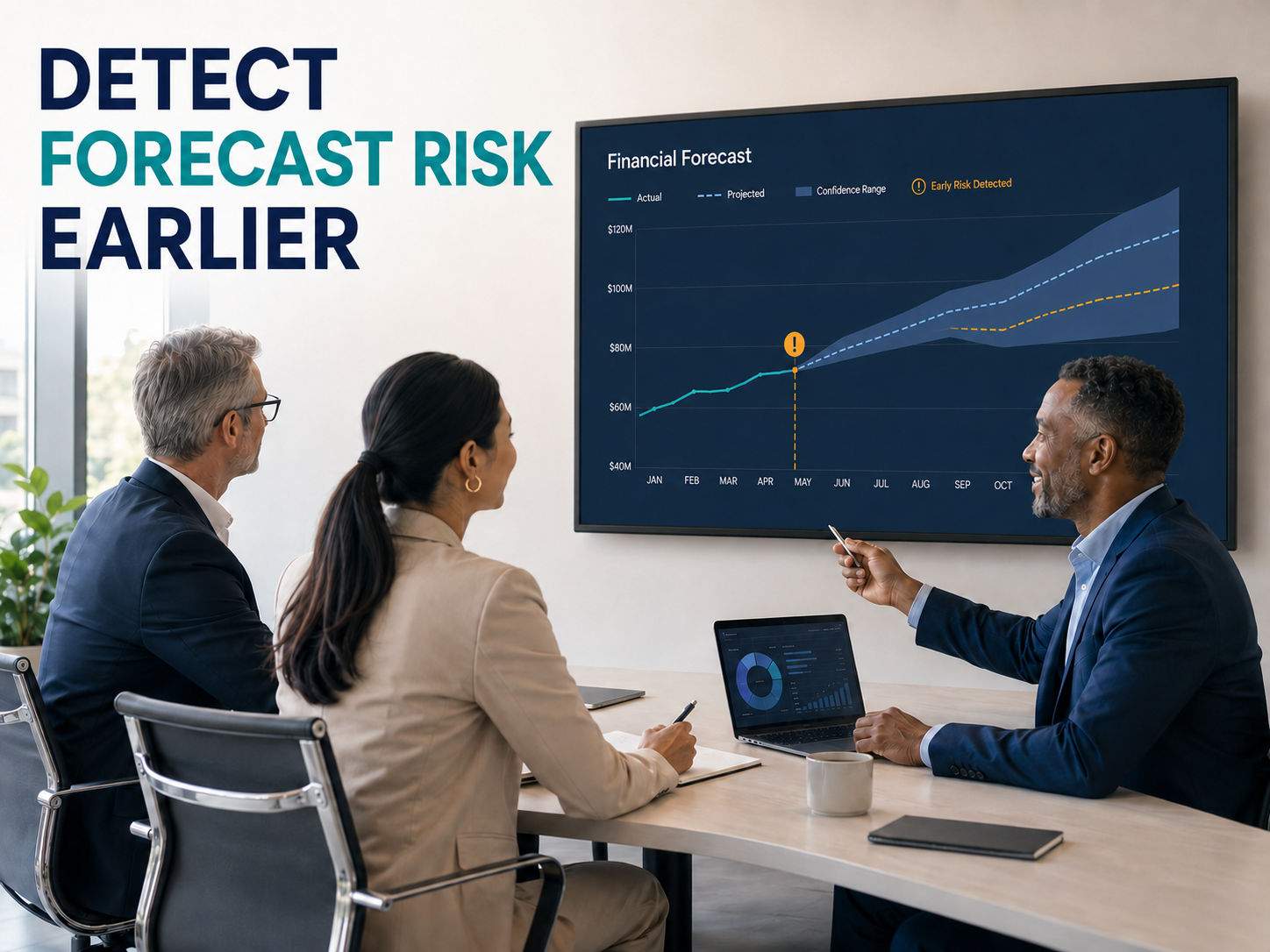
Forecast risk can begin with a series of small changes that do not appear substantial when viewed separately.
Revenue may begin to soften in one region, hiring costs may move above plan, customer payments may take longer to arrive, or a business unit may submit a forecast that depends on several favorable assumptions. Each development may seem manageable on its own, but together they can signal a broader shift that deserves attention.
The challenge for Finance is recognizing that pattern early enough to respond. Oracle AI helps Finance by analyzing planning data across the organization and identifying trends, anomalies, and forecasting behaviors that may point to emerging risk.
For Finance Directors, this creates an important advantage. Instead of waiting until the end of the month or quarter to explain what happened, Finance can begin evaluating what may be changing and what the organization should do next.
Traditional variance analysis only tells part of the story
Forecast-to-actual analysis remains an essential part of financial planning, but it is often focused on results that have already occurred. The period closes, actual results are loaded, reports are refreshed, and Finance begins reviewing the largest variances. The team then works with department leaders to understand why revenue, expenses, headcount, or cash flow differed from expectations.
That process provides valuable information, but it is primarily retrospective. By the time a meaningful variance appears in a report, the organization may have fewer options available to address it.
Oracle Cloud EPM Planning with Intelligent Performance Management (IPM) capabilities help Finance move beyond that traditional approach. Oracle AI can analyze planning data for recurring patterns, unusual activity, forecast bias, and meaningful differences between management forecasts and predictive results.
Rather than requiring Finance to review every account, department, product, and region with the same level of attention, Oracle IPM can help identify the areas that are most likely to require closer examination.
This does not replace the role of Finance. It allows Finance professionals to spend more time applying judgment and less time searching through large volumes of data for the first sign of a problem.
Forecast bias can affect the reliability of the entire plan
Every organization has planners who approach forecasting differently.
Some leaders consistently assume that revenue will finish above current trends. Others build conservative forecasts that they know they can exceed. Some forecasts reflect the most likely outcome, while others reflect the result the business would prefer to achieve.
A single missed forecast may be understandable, particularly when market conditions change. A repeated pattern of overestimating revenue or underestimating expenses is more significant because it can reduce confidence in the planning process.
Oracle AI can compare previous forecasts with actual performance and help identify recurring patterns of over-forecasting or under-forecasting. Finance can then determine whether the current forecast reflects the same behavior. This leads to a more productive conversation with the business.
Instead of asking why one number was missed, Finance can ask why a particular department, account, or business unit continues to forecast differently from what historical performance suggests. That discussion can uncover assumptions, incentives, or operational issues that may not be visible in a standard variance report.
Oracle AI provides the visibility needed to identify the pattern, while Finance provides the business context needed to understand it.
Predictive results provide Finance with a second perspective
One of the most practical benefits of Oracle AI is its ability to compare a management forecast with a prediction based on historical data and established patterns. The predictive result is not intended to replace the forecast submitted by the business. There may be valid reasons why management expects future performance to differ from the past.
A new customer contract may be nearing completion. A product launch may change revenue expectations. A restructuring may reduce costs in a way that historical data cannot anticipate. Market conditions may also be shifting faster than a predictive model can fully reflect.
When the business forecast and Oracle’s predictive result are closely aligned, Finance gains another level of support for the assumptions being used. When the two results are materially different, Finance has a clear reason to review the forecast more closely.
The difference may be fully justified, but it may also reveal an assumption that has not been sufficiently tested or documented.
Oracle AI gives Finance the ability to identify that gap during the planning process rather than after the period has ended.
Oracle AI can uncover patterns that are difficult to identify manually
Finance teams manage large volumes of information across accounts, entities, departments, products, customers, and planning periods.
Even an experienced team may struggle to identify a developing risk when it is distributed across hundreds or thousands of planning intersections. A small change in one location may not attract attention, but similar changes occurring across several areas may signal something more important.
Oracle AI can analyze these relationships at a scale that would be difficult to manage manually. It can help identify unusual values, unexpected volatility, recurring forecast behavior, and movements that differ from established historical patterns. These insights may point to a data-quality issue, a timing difference, a one-time business event, or an early change in operating performance.
Finance still determines what the insight means, but Oracle AI helps narrow the area that requires investigation.
The objective is not to remove professional judgment from the process, but to direct that judgment toward the areas where it can have the greatest impact.
Finance can focus on the variances that matter most
Not every variance deserves the same level of attention.
A five percent change may be material in one part of the business and insignificant in another. A relatively small variance may become important when it continues across several periods. A larger movement may be expected because of seasonality, a planned investment, or a known change in the business.
When every movement is treated as equally important, Finance teams can quickly become overwhelmed by reports and alerts that do not lead to meaningful action.
Oracle AI allows organizations to establish thresholds and compare results against relevant benchmarks, including prior periods, prior years, historical averages, and other planning scenarios. This gives Finance the ability to focus on changes that are more likely to affect performance or require a decision.
The goal is not to generate more alerts. The goal is to surface information that is relevant enough to support action.
When Oracle AI’s capabilities are configured around the way the organization manages performance, Finance receives a clearer and more practical view of where its attention is needed.
Earlier insight gives the organization more options
Identifying forecast risk early isn’t just better reporting. It’s the ability to respond while meaningful choices are still available. When a risk is discovered after the period closes, Finance may be limited to explaining the result, revising the forecast, and adjusting leadership’s expectations.
When that same risk is identified during the planning cycle, the organization may still have time to adjust spending, revise hiring plans, reallocate resources, model alternative scenarios, address a developing cash-flow concern, or prepare leadership for a range of possible outcomes. This changes the role Finance can play in the organization.
Instead of arriving after the fact with a variance explanation, the Finance Director can bring a forward-looking perspective to leadership. Finance can explain what appears to be changing, describe the potential effect on performance, and recommend which decisions should be considered.
Oracle AI gives Finance the tools to begin that conversation earlier and with greater confidence.
Oracle AI strengthens the connection between data and judgment
There is a tendency to describe AI as though the objective is to automate the entire planning process and remove people from the forecast. That view overlooks the most valuable role AI can play in Finance.
Oracle AI can analyze large volumes of planning data, compare forecasts with actual and predictive results, identify recurring bias, and surface unusual patterns. Finance professionals bring an understanding of the business, awareness of current conditions, and the judgment needed to determine how the organization should respond.
These capabilities are most effective when they work together.
Oracle AI provides analytical reach and consistency that would be difficult to achieve manually. Finance provides the context and experience required to turn those insights into decisions. The result is not a forecast that operates without people. It is a planning process in which people can work more effectively.
A strong planning foundation remains essential
Oracle AI delivers the greatest value when it is supported by a well-designed planning environment.
Historical forecasts should be retained so the organization can evaluate forecast accuracy and identify recurring bias. Data definitions should be consistent across departments and systems. Planning models should reflect how the business is managed. Thresholds should be configured around what leadership considers material.
These elements are not separate from the technology. They are part of creating a mature and reliable planning process.
Oracle AI provides powerful capabilities for analyzing data and surfacing insights, but the organization must still establish accountability for the assumptions behind the forecast.
Technology can identify an unusual pattern, but Finance and the business must determine what caused it. AI can highlight forecast bias, but leadership must decide how that behavior should be addressed. The system can point to a potential risk, but the organization must choose what action to take.
When the technology, process, and accountability are aligned, Finance gains more than a better forecast. It develops a more informed and responsive approach to managing performance.
How US-Analytics can help
US-Analytics helps organizations turn Oracle’s planning and AI capabilities into practical improvements in the way Finance operates.
We work with finance teams to identify where Oracle IPM and predictive planning can provide the greatest benefit. This may include evaluating data and model readiness, identifying areas where forecast risk is difficult to see, configuring meaningful insights and thresholds, and developing workflows.
US-Analytics also helps organizations strengthen the planning foundation behind the technology. This can include improving planning models, integrating reliable data, preserving forecast history, reducing manual processes, and aligning the solution with the decisions leadership needs to make.
Our goal is to help clients get more from their Oracle AI investment by connecting the technology to the way the business plans, evaluates performance, and makes decisions.
When Oracle AI is implemented with the right structure and business context, Finance Directors can spend less time searching for risk and more time helping the organization respond to it.
AI does not eliminate forecast risk. It gives Finance an earlier opportunity to understand it and act.


