



AI has been part of HR for years, from reporting and analytics to basic chatbots. But a new class of technology—AI agents—is starting to change not just how information is delivered, but how work actually gets done.
Unlike traditional AI tools that offer predictions or suggestions, AI agents are designed to take action. They can interpret requests, pull information from multiple systems, make decisions based on context, and complete tasks with minimal human involvement—while still keeping people in control.
For HR teams facing growing workloads and rising employee expectations, AI agents offer a practical way to reduce administrative burden and refocus time on people, not processes.
What Makes AI Agents Different?
At a high level, AI agents are intelligent software programs that can:
- Understand requests made in natural language
- Observe what’s happening across systems and data sources
- Decide what steps are needed to complete a task
- Execute those steps or coordinate with other agents
- Learn and improve based on feedback and outcomes
What sets agents apart from earlier AI tools is their ability to act independently within defined boundaries. They don’t just surface insights—they can update records, trigger workflows, generate documents, and notify the right people when human input is required.
AI Agents in the Context of HR
In HR, AI agents can be embedded directly into day-to-day workflows such as recruiting, onboarding, performance management, compensation, and benefits administration.
Because they’re connected to core HR systems (like HCM platforms), AI agents can securely access employee data, policies, historical records, and even external benchmarks. That allows them to deliver responses and actions that are personalized, accurate, and context-aware.
For example:
- An employee asks a question about benefits coverage
- An agent retrieves the relevant plan details, eligibility rules, and employee-specific data
- The agent explains the answer in plain language and flags anything that requires HR review
All of this can happen in seconds, without a ticket, email, or manual lookup.
How AI Agents Work Together
AI agents are often designed as specialists, each responsible for a specific function. Some focus on conversation and interaction, while others handle data retrieval, analysis, or execution.
A typical interaction might look like this:
- A conversational agent receives a question from an employee or manager
- A coordinating agent determines what information or actions are needed
- Specialized agents gather data from HR systems, documents, or external sources
- The response is reviewed for accuracy and shared back with the user
This multi-agent approach allows HR teams to automate complex, multi-step requests while maintaining oversight and control.
Why Human Oversight Still Matters
While AI agents can operate autonomously, they perform best when humans stay involved. HR professionals help shape agent behavior by:
- Reviewing recommendations
- Providing feedback on outputs
- Approving sensitive actions
- Adjusting rules and guardrails over time
This “human-in-the-loop” approach ensures automation remains aligned with company policies, compliance requirements, and organizational values.
The Building Blocks of HR AI Agents
Most HR-focused AI agents follow a similar operating model:
Inputs
Agents consume both structured data (like job levels or pay bands) and unstructured data (like performance feedback or policy documents).
Decision logic
Using large language models and contextual data, agents determine what steps to take next—whether that’s answering a question, escalating an issue, or triggering another process.
Actions
Agents complete tasks directly or coordinate with other systems and agents to move work forward.
Together, these components allow agents to manage requests end to end, not just respond to them.
The Value AI Agents Bring to HR Teams
Organizations adopting AI agents in HR are seeing benefits across several areas:
Less administrative work
Routine tasks like document creation, data updates, and policy explanations can be handled automatically, freeing HR teams to focus on strategic initiatives.
Better, faster decisions
Agents can analyze workforce data, market benchmarks, and historical trends to support decisions around compensation, development, and workforce planning.
Lower operational costs
By reducing manual effort and support tickets, AI agents help HR teams do more without expanding headcount.
Improved employee experience
Employees get faster, clearer answers and consistent support—without waiting in queues or navigating complex systems.
Common HR Use Cases for AI Agents
Performance and Career Development
Agents can assist with drafting performance reviews, summarizing peer feedback, tracking goals, and suggesting development opportunities based on skills and interests.Learning and Training
Employees can ask agents to recommend courses, enroll them in training, and capture feedback on learning programs.Compensation and Benefits
Agents can explain pay structures, benefits eligibility, leave balances, and tax options in clear language, while routing complex cases to HR when needed.Time, Leave, and Absence
From timecard questions to leave requests, agents can guide employees through policies and initiate approvals.Onboarding and Employee Changes
New hires can be guided through required steps, deadlines, and policies, while agents help existing employees update personal or employment information. 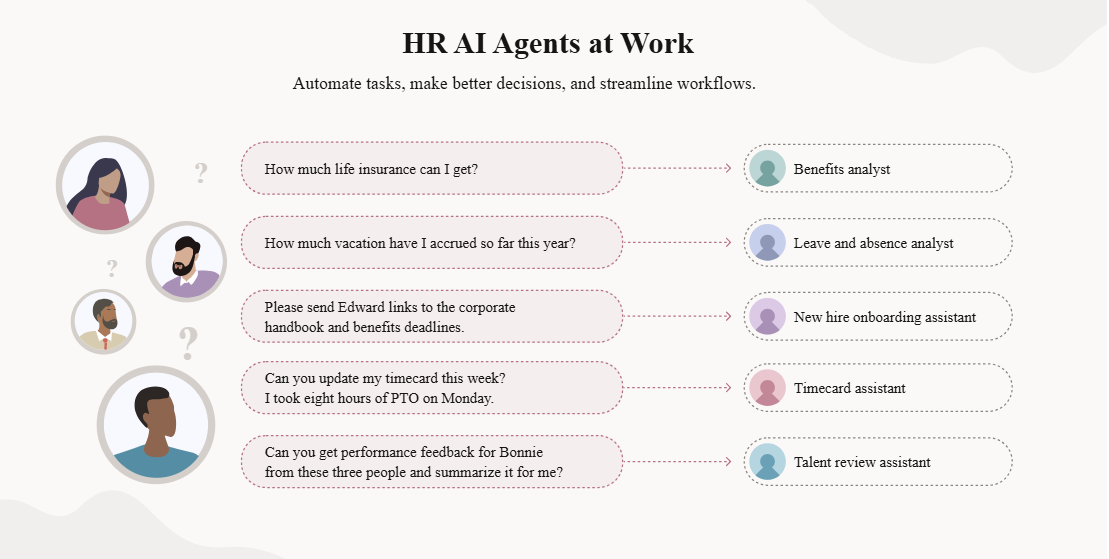
Integration Is Key
AI agents are most effective when they’re connected across systems—not just HR, but finance, payroll, and other enterprise platforms. This allows organizations to:
- Maintain consistent data
- Enforce security and access controls
- Provide managers with accurate, real-time insights
Strong integration also reduces risk by ensuring sensitive data is governed at the platform level.
Looking Ahead
AI agents represent a shift in how HR work gets done. Instead of adding more tools or dashboards, organizations can automate entire workflows while keeping people involved where judgment and empathy matter most.
As these capabilities continue to mature, HR teams have an opportunity to move beyond administrative support and focus more fully on employee engagement, development, and long-term workforce strategy.


